At Clínica Áureo, we perform high-resolution diagnostic ultrasound examinations for the assessment of the face, neck, and other superficial tissues of the body. This medical imaging technique allows real-time visualization of anatomical structures such as muscles, blood vessels, glands, subcutaneous tissue, cysts, lipomas, and other soft tissue lesions without the use of radiation and in a completely painless manner.
Ultrasound has become an essential tool for both medical diagnosis and the planning and follow-up of aesthetic medicine treatments. Thanks to the high-definition images obtained, it is possible to achieve a more precise, personalized, and safer assessment of each patient.
At our clinic in Palma de Mallorca, we use high-resolution ultrasound technology to complement the clinical examination and obtain detailed information that is not always visible through simple observation or palpation. Our Clarius L20 HD3 high-resolution ultrasound system enables diagnostic assessment of the face, neck, superficial tissues, and dermal fillers with a high level of accuracy and safety.
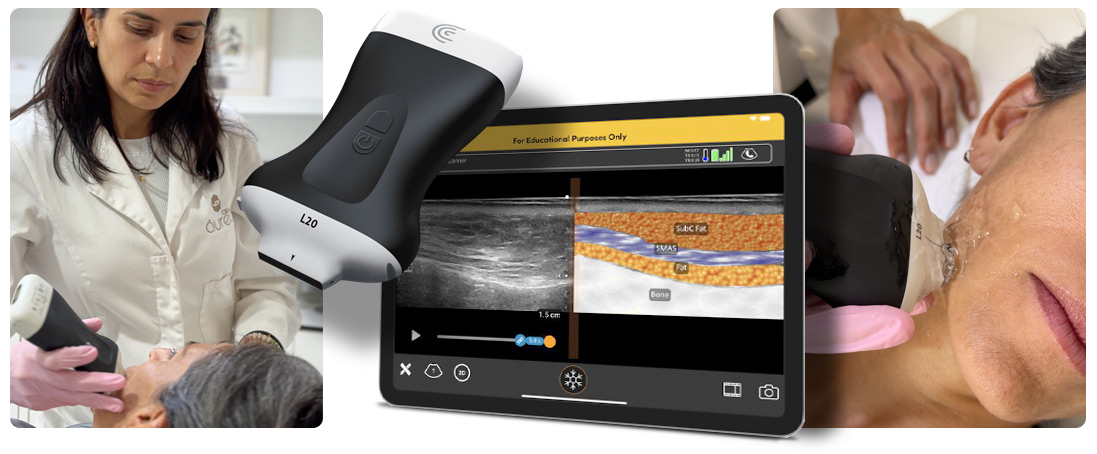
Diagnostic ultrasound is an imaging test that uses sound waves to generate real-time images of the body's internal structures.
Unlike other diagnostic techniques, it does not use ionizing radiation, is completely safe, and allows tissues to be examined dynamically during the assessment.
High-frequency probes are particularly suitable for the analysis of superficial structures, providing excellent visualization of facial anatomy, the neck, and other areas of the body where a high level of detail is required.
High-resolution ultrasound offers numerous advantages for both diagnosis and the planning of medical and aesthetic treatments:
High-resolution ultrasound can be used to assess multiple superficial anatomical regions.
FACE
Facial ultrasound allows the evaluation of:
Facial ultrasound enables a precise assessment of each patient's anatomy, identification of vascular structures, evaluation of soft tissues, and analysis of dermal fillers. For this reason, it has become an increasingly valuable tool in both medical diagnosis and advanced aesthetic medicine.
It is particularly useful for understanding each patient's unique anatomy and performing accurate assessments before or after specific treatments.
NECK
Ultrasound examination of the neck allows the evaluation of:
SUPERFICIAL BODY TISSUES
In addition to the face and neck, ultrasound can be used to assess other superficial areas of the body:
This type of examination is also known as soft tissue ultrasound and allows the assessment of localized abnormalities in superficial tissues without the need for more complex imaging tests in a wide variety of clinical situations.
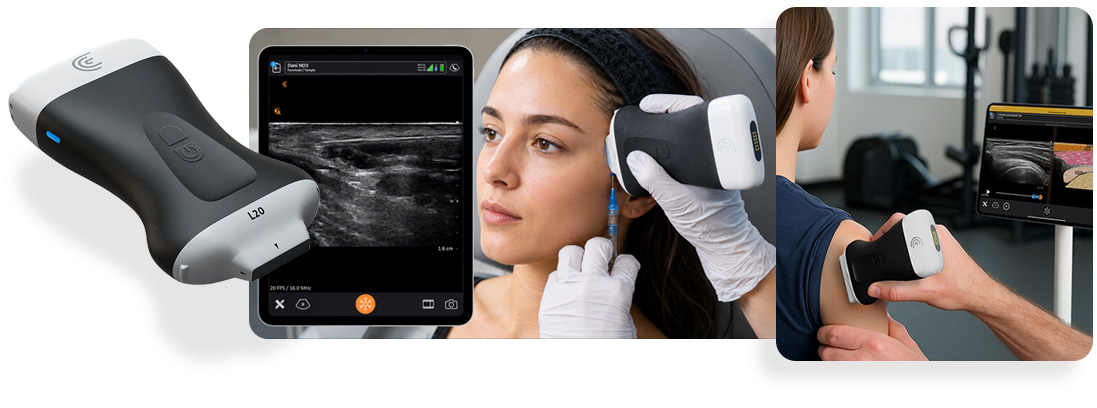
Ultrasound has become a highly valuable tool in modern aesthetic medicine.
It allows practitioners to understand the patient's anatomy with greater precision and improve the safety of numerous procedures.
Assessment prior to aesthetic treatments
Before performing certain procedures, ultrasound allows the identification of blood vessels, relevant anatomical structures, and individual characteristics that may influence treatment planning.
Evaluation of dermal fillers
The high resolution of the Clarius L20 HD3 system allows precise identification of previously injected fillers, assessment of their location, and analysis of associated changes, providing valuable information for clinical decision-making.
Diagnosis of complications
At Clínica Áureo, we perform our examinations using the Clarius L20 HD3 ultrasound system, a high-frequency ultrasound device specifically designed for the assessment of superficial structures.
Its exceptional resolution allows detailed visualization of facial anatomy, soft tissues, superficial blood vessels, salivary glands, dermal fillers used in aesthetic medicine, and other anatomical structures relevant to diagnosis and treatment planning.
The image quality obtained facilitates more accurate patient assessments, improves diagnostic capabilities, and contributes to greater safety in medical and aesthetic medicine procedures.
Thanks to real-time visualization, it is possible to evaluate each patient's anatomy and accurately monitor lesions, soft tissue abnormalities, and previous treatments.
The examination is carried out in the clinic and typically lasts between 15 and 30 minutes.
During the procedure:
1. A conductive gel is applied to the skin.
2. The ultrasound probe is placed over the area to be examined.
3. Images are displayed in real time.
4. The physician interprets the findings during the consultation.
No special preparation is required, and patients can immediately return to their normal daily activities.
High-resolution ultrasound may be recommended in situations such as:
High-resolution diagnostic ultrasound allows the assessment of the face, neck, and other superficial tissues of the body to identify cysts, lipomas, enlarged lymph nodes, salivary gland disorders, inflammation, soft tissue lesions, and dermal fillers.
In addition, it helps plan aesthetic medicine treatments and provides more accurate follow-up through real-time imaging.
No. It is a completely painless and non-invasive procedure.
No. Ultrasound uses sound waves and does not emit ionizing radiation.
It generally lasts between 15 and 30 minutes, depending on the area being examined.
Yes. Ultrasound is a particularly useful tool for evaluating fillers and determining their location.
At Clínica Áureo, we perform our examinations using the Clarius L20 HD3 high-resolution ultrasound system, a technology especially suited for the assessment of the face, neck, and other superficial tissues. Its ability to generate high-definition images allows precise anatomical evaluations and enhances diagnostic safety.
Yes. The assessment is performed during the consultation, and the findings can be discussed immediately.
Yes. It helps physicians better understand each patient's anatomy and increases the safety of certain procedures.
At Clínica Áureo, we combine medical expertise, advanced technology, and a personalized approach to provide high-resolution diagnostic ultrasound examinations focused on accurate diagnosis, treatment planning, and patient follow-up.
The incorporation of the Clarius L20 HD3 system allows us to perform detailed examinations of the face, neck, and superficial tissues, providing valuable anatomical information for both diagnostic and aesthetic medicine purposes.
If you are looking for high-resolution diagnostic ultrasound in Palma de Mallorca, Clínica Áureo offers advanced technology, medical expertise, and personalized assessment for the examination of the face, neck, and superficial tissues of the body.
Follow us on